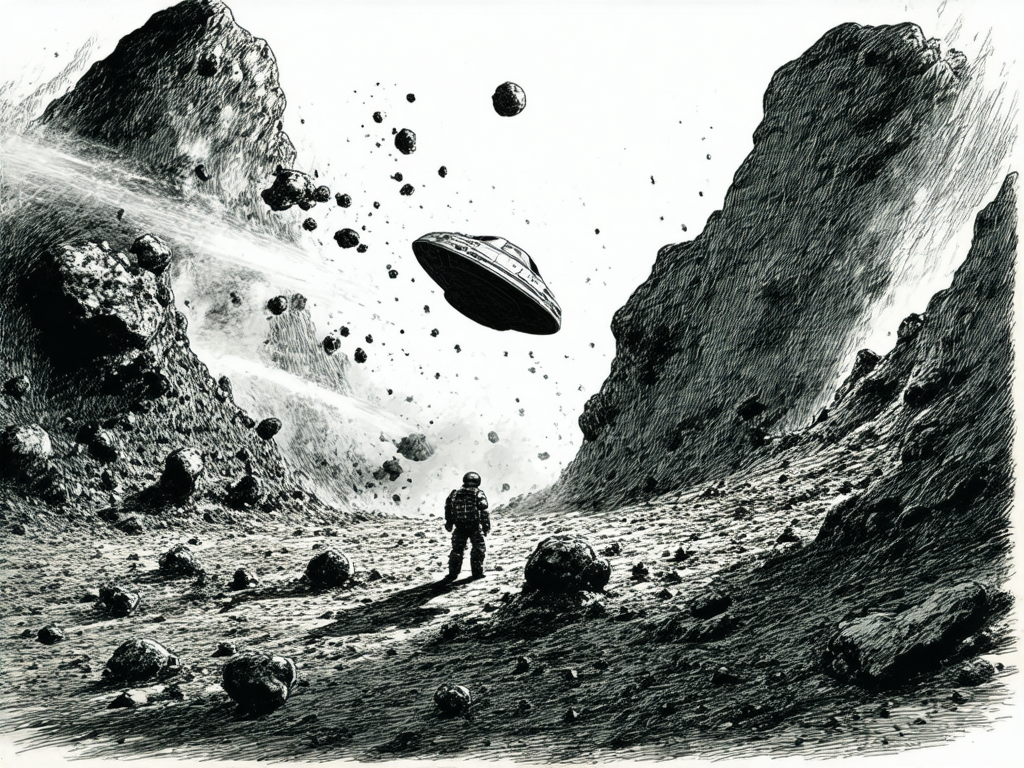
Hayabusa-2’s Asteroid Bombing: A Glimpse Into Humanity’s Risky Reach
The Japanese spacecraft Hayabusa-2 made history in 2019 when it successfully landed on and detonated a small asteroid, creating a crater that exposed the celestial body’s inner secrets. The mission, part of an ambitious plan to study the origins of the solar system, was a feat of engineering and human ingenuity. But as we celebrate this technological milestone, it also serves as a stark reminder of humanity’s growing ability—and perhaps recklessness—to alter the natural world in ways that could have far-reaching consequences.
A Dance With Fire: The Asteroid Bombing Explained
Hayabusa-2’s mission was not just about scientific curiosity. It was an audacious attempt to understand the building blocks of our solar system by studying asteroid Ryugu, a primitive object thought to contain materials dating back to the formation of the Earth and beyond. To achieve this, the spacecraft used a small explosive device to blast a crater into the asteroid’s surface, ejecting material that could then be collected and analyzed.
The explosion, while controlled and precise, was still a staggering display of human power over nature. It raised questions about the ethics of such interventions in space—and whether we are prepared to handle the consequences of our actions on a cosmic scale.
A Risky Business: The Broader Implications
The asteroid bombing experiment is a microcosm of humanity’s broader relationship with the planet and beyond. As we push deeper into space, colonize other worlds, and manipulate celestial bodies for our own purposes, we risk overstepping boundaries that we don’t fully understand.
One of the most pressing concerns is the potential for unintended environmental consequences. While Ryugu is a lifeless rock, similar missions could target asteroids or other bodies that may harbor forms of extraterrestrial life—or at least contain materials critical to sustaining life elsewhere in the universe. The ethical implications of altering these environments, even unintentionally, are profound.
Moreover, the technology developed for such missions could be weaponized. The line between peaceful exploration and military aggression is increasingly blurry, raising questions about how we regulate space activities moving forward.
Power Dynamics in Space: Who Controls The Final Frontier?
The Middle East and North Africa (MENA) region has long been a crossroads of civilizations, cultures, and ideas. Yet, when it comes to space exploration, the region’s involvement is often overshadowed by global powers like the United States, China, and Russia.
Hayabusa-2’s mission highlights the growing competition in space, where nations are vying for dominance not just for scientific gain but for political and economic advantage. This raises questions about inclusivity and equity in space exploration. Who gets to decide how resources in space are used? And what safeguards exist to prevent exploitation?
The MENA region has its own space ambitions, with countries like the UAE, Saudi Arabia, and Israel investing heavily in space programs. Yet, these efforts often align with broader geopolitical strategies rather than addressing pressing regional issues like social justice or environmental sustainability.
A Call For Humility: Balancing Ambition With Responsibility
Hayabusa-2’s asteroid bombing is a testament to human ingenuity but also a cautionary tale about our hubris. As we push further into space, it’s crucial to approach these endeavors with humility and a deep sense of responsibility.
We must ask ourselves tough questions: Are we using space exploration to uplift humanity, or are we exploiting it for narrow self-interest? How can we ensure that the benefits of such missions are shared equitably, both among nations and across generations?
The answers to these questions will shape not just our future in space but also our ability to address pressing challenges here on Earth. After all, the lessons we learn from exploring the cosmos often mirror the ones we need to apply at home.
Looking Ahead: A New Era Of Space Stewardship
As humanity continues its risky reach into the stars, it’s essential to approach this endeavor with a commitment to collaboration, sustainability, and justice. The days of unchecked exploitation in space must give way to a new era of stewardship—one where we understand that our power to shape the universe comes with great responsibility.
For all its scientific achievements, Hayabusa-2’s mission leaves us with an enduring reminder: We are but stewards of this planet, and perhaps one day, the cosmos as well. Let’s ensure that we rise to this challenge with wisdom and compassion, not just ambition.
About the Author:
Aisha Malik is Middle East Bureau Chief at our publication. Bilingual journalist covering Middle Eastern politics and culture. Her reporting bridges the gap between local traditions and global trends, offering unique insights.
 Bilingual journalist covering Middle Eastern politics and culture. Her reporting bridges the gap between local traditions and global trends, offering unique insights.
 Award-winning reporter specializing in climate change and environmental policy. His work has taken him from the Amazon rainforest to polar regions, documenting the human impact of global warming.
 Veteran journalist with over 15 years of experience leading international news operations. Known for her visionary approach to storytelling and editorial strategy, Jane has guided award-winning investigations across continents.
 Tech and innovation reporter with a focus on the intersection of technology and society. Her work explores how advancements impact global communities and economies.
 Urban affairs correspondent focusing on the challenges and opportunities of rapid urbanization. His work examines how cities shape and are shaped by global trends.