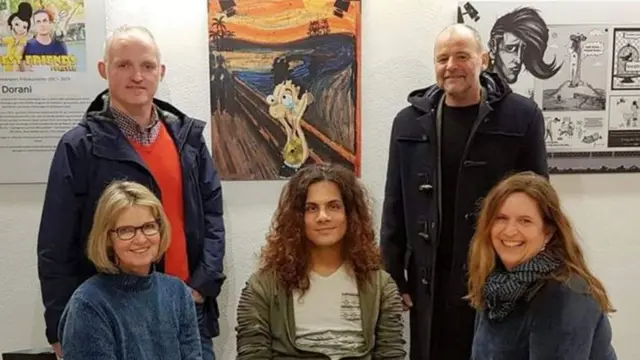
The world is a cage, but Ali Dorani’s cartoons are the key that unlocks its doors, bridging the gap between Iran’s restrictive environment and the open spaces of Australia. Born in Tehran, Dorani’s work is a testament to the resilience of art in the face of censorship and oppression. His cartoons, shared widely on social media, offer a lifeline—a way for people across the globe to see beyond the walls that constrain, and to engage with stories that resonate universally.
A World Behind Bars
Iran, under President Hassan Ruhani’s leadership, has seen some reforms since 2013. However, freedom of expression remains stifled. Journalists, activists, and artists face constant threats, with many imprisoned for their work. Dorani, a journalist turned cartoonist, knows this reality all too well. His cartoons often critique the regime, but he must walk a fine line to avoid censorship or worse.
“Every time I draw, I feel like I’m walking on thin ice,” Dorani once said in an interview. “But if I don’t speak out, who will?”
His work is a blend of humor and satire, tackling issues from political corruption to human rights abuses. A recent cartoon depicted a bird trapped inside a cage labeled “Iran.” The bird’s wings are clipped, symbolizing the suppression of free expression. Yet, in the background, the bird’s tail feathers subtly extend beyond the cage, hinting at the possibility of escape—a metaphor for the resilience of artistic expression.
From Tehran to Sydney
Australia is a world away from Iran, yet Dorani’s cartoons have found a home here. The land Down Under is known for its vibrant arts scene and progressive values, but it too has its challenges. In recent years, political correctness debates have sparked tensions, and media consolidation has reduced diversity of voice.
Dorani’s work resonates with Australians who value free expression and cultural exchange. His cartoons are shared on social media platforms, where they spark conversations about global issues—be they climate change, migration, or democracy.
One cartoon that went viral in Australia depicted a man holding a sign reading “Refugees Welcome,” while another showed a wall being built around the world, with countries like Iran and Australia on opposite sides. The images struck a chord, encouraging followers to think about their place in an increasingly fragmented world.
Social Media as a Lifeline
The digital age has been both a blessing and a curse for artists like Dorani. While governments can monitor and restrict content more easily than ever before, social media also offers unprecedented opportunities to share work globally. For Dorani, platforms like Twitter and Instagram have become his lifeline—a way to bypass Iran’s state-controlled media and connect directly with audiences worldwide.
“Without social media, my voice would be silenced,” he says. “But here, I can reach people who understand the struggles of those living under oppression.”
Art as a Tool for Resistance
Dorani’s cartoons are more than just political commentary; they’re a tool for resistance. By using humor and satire, he makes complex issues accessible to a broad audience. His work has inspired other Iranian artists to speak out, creating a growing network of activists who use art to challenge the status quo.
In Australia, his influence is subtle but powerful. As the country grapples with its own challenges—like debates over asylum policies and reconciliation with Indigenous communities—Dorani’s cartoons remind Australians of their shared humanity with people half a world away.
A Global Exchange
The exchange between Iran and Australia through Dorani’s art highlights the importance of cultural dialogue in today’s fractured world. It shows how even in times of political division, art can serve as a bridge—a way to understand each other across borders and cultures.
Dorani’s journey from Tehran to global audiences is a testament to the enduring power of creativity. His cartoons are not just a lifeline for himself but for anyone seeking to break free from the constraints of their reality. In a world that often feels divided, his work reminds us that art can be both a mirror and a window—a way to see ourselves and others more clearly.
As Dorani continues to draw, he carries with him the hope that one day, cages will fall, and the world will be a freer place—where artists like him can express themselves without fear. Until then, his cartoons will keep bridging worlds, reminding us all of the power of art to transcend borders and bring people together.
About the Author:
Tom O’Connor is Economy Editor at our publication. Economist turned journalist, Tom specializes in global economic inequality and its impact on social structures. His work is both analytical and deeply human.
 Bilingual journalist covering Middle Eastern politics and culture. Her reporting bridges the gap between local traditions and global trends, offering unique insights.
 Award-winning reporter specializing in climate change and environmental policy. His work has taken him from the Amazon rainforest to polar regions, documenting the human impact of global warming.
 Veteran journalist with over 15 years of experience leading international news operations. Known for her visionary approach to storytelling and editorial strategy, Jane has guided award-winning investigations across continents.
 Tech and innovation reporter with a focus on the intersection of technology and society. Her work explores how advancements impact global communities and economies.
 Urban affairs correspondent focusing on the challenges and opportunities of rapid urbanization. His work examines how cities shape and are shaped by global trends.