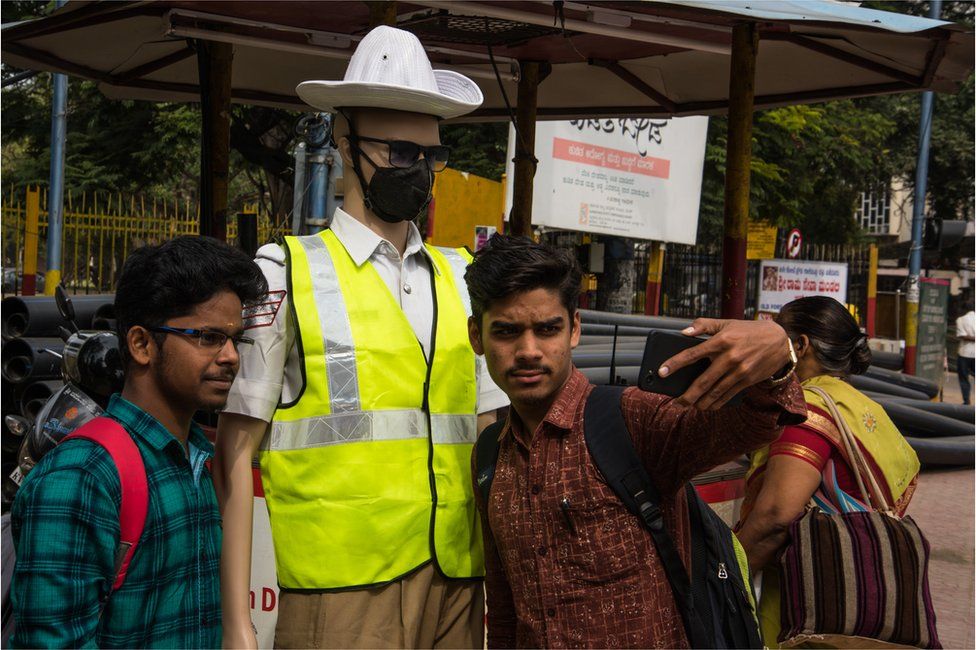
In the heart of Bangalore, India’s silicon capital, where traffic chaos reigns supreme and air pollution chokes its citizens, a peculiar sight has begun to emerge: dummy police officers standing stoically at road intersections, their reflective uniforms glinting under the tropical sun. At first glance, these life-sized fiberglass replicas might seem like a prank or an odd art installation, but they are part of a bold experiment aimed at curbing the city’s notoriously unruly traffic and its contribution to public health crises.
The concept is deceptively simple: place dummy cops where real ones would typically stand to monitor traffic. The idea is that drivers,惯ually flouting traffic rules with impunity, might think twice before speeding or ignoring signals if they believe they are being watched—even if the watcher is not real. The initiative, launched earlier this year, has already sparked a heated debate about the ethics of deception in law enforcement and its potential to foster safer, more responsible driving habits.
But beyond the novelty lies a deeper question: can trickery ever replace genuine accountability? And what does it say about a society where citizens feel compelled to resort to such measures to enforce basic norms?
Bangalore’s traffic woes are no secret. The city, with its population of over 10 million, is notorious for its gridlocked streets and chaotic driving culture. According to recent data, traffic-related accidents claim hundreds of lives each year, while emissions from vehicles contribute significantly to the city’s poor air quality—a pressing health concern that disproportionately affects marginalized communities.
Efforts to tackle these issues have been met with limited success. Traditional policing methods, already stretched thin by limited resources and overburdened officers, struggle to keep up with the demands of managing traffic in one of India’s fastest-growing cities. Enter the dummy cops: a low-cost, high-impact solution that has captured the imagination—and skepticism—of Bangaloreans.
The dummy cops are strategically placed at key intersections, their fiberglass frames reinforced with metal for durability. Equipped with reflective surfaces and realistic features like reflective sunglasses and whistles, they mimic real police officers standing duty. The idea is to create a psychological deterrent: drivers who pass by these faux执法人员 might think twice about breaking the law, fearing that they could be caught on camera or cited for violations.
Early reports suggest that the initiative has had some measurable impact. At intersections where dummy cops were installed, traffic violations like speeding, jaywalking, and ignoring traffic signals have decreased by up to 30 percent, according to data collected by local authorities. Accidents at these locations have also dropped, though officials caution that this may be due to a combination of factors, including increased visibility for pedestrians.
But not everyone is convinced. Critics argue that relying on deception undermines the trust between citizens and law enforcement—a cornerstone of any just society. “If people think they can break the rules as long as there’s no real cop around, what does that say about our values?” asks Anjali Rao, a Bangalore-based activist who works on urban planning issues.
Others question whether the dummy cops are merely a band-aid solution to a deeper problem. “The real issue is not just enforcing traffic laws,” says Rahul Kumar, a transport policy analyst at the Indian Institute for Urban Management. “It’s about creating a culture of respect for public spaces and shared resources.”
Still, supporters argue that the initiative is a step in the right direction—one that could pave the way for more innovative approaches to public safety. “We need to think outside the box when traditional methods aren’t working,” says Dr. Sunita Hazarika, a public health expert who has been advocating for creative solutions to Bangalore’s traffic problems. “If dummy cops can save lives and reduce pollution, then they’re worth exploring.”
As the debate rages on, one thing is clear: Bangalore’s experiment with dummy cops has sparked a broader conversation about the role of deception in governance and its implications for social justice. Whether this initiative will lead to lasting change or remain a gimmick remains to be seen. But for now, these fiberglass officers stand as a quirky reminder that even in the face of systemic failures, communities are willing to try unconventional approaches to protect their health and safety.
In a city where every day feels like a battle for survival on the roads, perhaps the dummy cops are just the beginning.
About the Author:
Carlos Rivera is Senior Correspondent at our publication. Award-winning reporter specializing in climate change and environmental policy. His work has taken him from the Amazon rainforest to polar regions, documenting the human impact of global warming.
 Bilingual journalist covering Middle Eastern politics and culture. Her reporting bridges the gap between local traditions and global trends, offering unique insights.
 Award-winning reporter specializing in climate change and environmental policy. His work has taken him from the Amazon rainforest to polar regions, documenting the human impact of global warming.
 Veteran journalist with over 15 years of experience leading international news operations. Known for her visionary approach to storytelling and editorial strategy, Jane has guided award-winning investigations across continents.
 Tech and innovation reporter with a focus on the intersection of technology and society. Her work explores how advancements impact global communities and economies.
 Urban affairs correspondent focusing on the challenges and opportunities of rapid urbanization. His work examines how cities shape and are shaped by global trends.