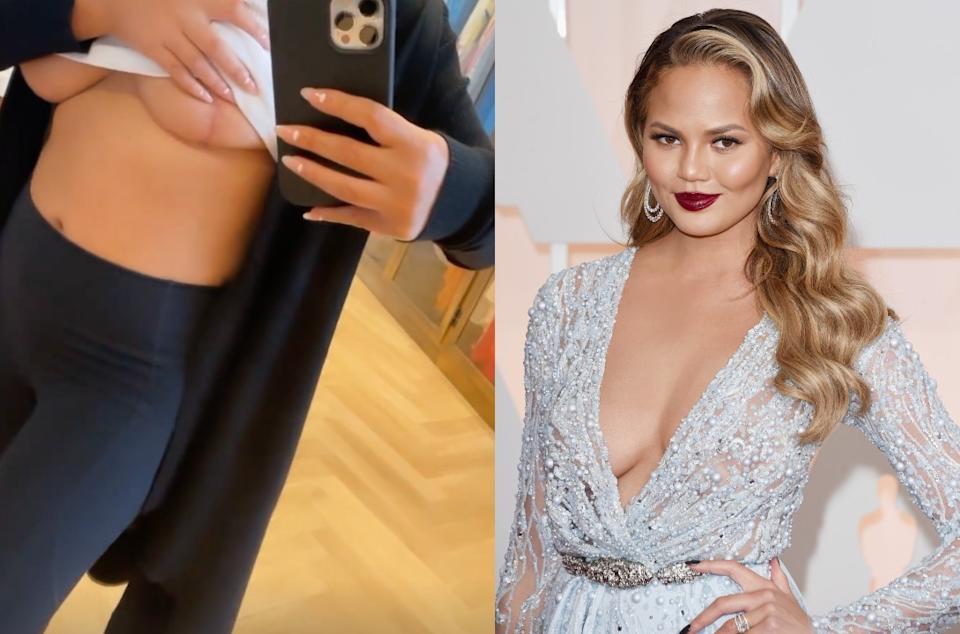
Chrissy Teigen Embodies Empowerment inImplant Removal Journey
In a world where societal pressures often dictate how women should look and feel, Chrissy Teigen’s recent decision to remove her breast implants has sparked a powerful conversation about body autonomy, self-acceptance, and the unapologetic embrace of one’s own truth. While many may view this as a personal choice, Teigen’s journey is a microcosm of a broader cultural shift—one that resonates deeply in the Middle East and North Africa (MENA), where traditional values are increasingly clashing with modern, progressive ideals.
Teigen’s decision to remove her implants was not merely an aesthetic choice; it was a statement. It challenged the notion that women must conform to beauty standards imposed by society, whether through natural means or augmentation. Her honesty about the emotional and physical toll of living with implants—describing them as “painful” and “icky”—highlighted the often-overlooked struggles faced by women who feel pressured to alter their bodies for validation.
This narrative is not unique to Teigen’s experience; it echoes the stories of countless women across the globe, including those in the MENA region. In a culture where female beauty is heavily commodified and often tied to identity, many women face similar dilemmas. The rise of social media has amplified these conversations, allowing women to share their experiences and find solidarity in their collective struggles.
In the Middle East, the conversation around body image and empowerment is particularly nuanced. Traditional values emphasize modesty and family honor, which can sometimes conflict with modern notions of individuality and self-expression. However, a growing number of young women are pushing back against these norms, embracing their bodies as a source of strength and pride rather than shame.
Teigen’s journey serves as a reminder that empowerment is not about fitting into society’s mold but about breaking it. Her decision to reclaim her body on her own terms aligns with the broader progressive values of self-determination and authenticity—a message that resonates deeply in the MENA region, where women are increasingly vocal about their rights to define themselves.
As we continue to navigate a world where beauty standards and cultural expectations often feel like chains, stories like Teigen’s offer a beacon of hope. They remind us that true empowerment lies not in conforming to external ideals but in embracing our unique truths. In the Middle East and beyond, this movement is gaining momentum, with women using their voices—and their choices—to rewrite the narrative.
About the Author:
Aisha Malik is Middle East Bureau Chief at our publication. Bilingual journalist covering Middle Eastern politics and culture. Her reporting bridges the gap between local traditions and global trends, offering unique insights.
 Bilingual journalist covering Middle Eastern politics and culture. Her reporting bridges the gap between local traditions and global trends, offering unique insights.
 Award-winning reporter specializing in climate change and environmental policy. His work has taken him from the Amazon rainforest to polar regions, documenting the human impact of global warming.
 Veteran journalist with over 15 years of experience leading international news operations. Known for her visionary approach to storytelling and editorial strategy, Jane has guided award-winning investigations across continents.
 Tech and innovation reporter with a focus on the intersection of technology and society. Her work explores how advancements impact global communities and economies.
 Urban affairs correspondent focusing on the challenges and opportunities of rapid urbanization. His work examines how cities shape and are shaped by global trends.