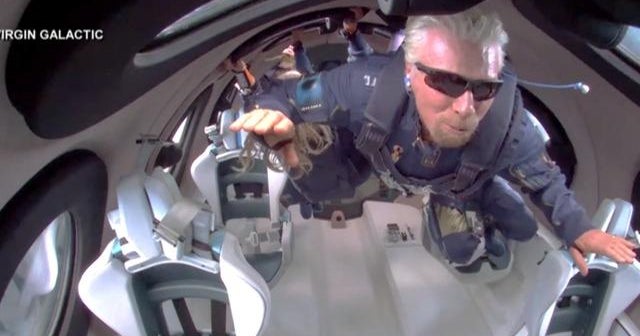
As the engines roared to life, Richard Branson stood at the threshold of yet another frontier. His journey into space was more than just a daredevil stunt; it was a metaphor for the infinite possibilities that lie beyond our current grasp—a reminder that human ambition, when coupled with vision, can rewrite the boundaries of what we once thought was possible.
Branson’s flight was not merely about reaching the edge of space but about challenging the limits of imagination. It was a testament to the power of perseverance and risk-taking, qualities that have defined his career as much as his personal ethos. Yet, as he soared above the atmosphere, the world watched—not just for the spectacle, but for what it might signify about our collective future.
The Quest for Equality in the Skies
Decades ago, air travel was a luxury reserved for the wealthy. But Branson’s first venture into budget airlines democratized flight, making it accessible to millions who had never before experienced the freedom of the skies. Today, his latest endeavor feels like a continuation of that ethos—except on a grander scale. Yet, there is a tension here: while space tourism promises to open new frontiers for exploration, its current iteration reflects the same inequalities we seek to overcome on Earth.
A New Frontier Divided
The privatization of space travel raises questions about who gets to benefit from such innovations. Will it follow the trajectory of air travel, becoming more accessible over time? Or will it remain a playground for the privileged, reinforcing existing power structures?
As Branson’s spaceship pierced the stratosphere, the world wondered: What does this mean for those still grounded by systemic barriers—economic inequality, lack of education, or displacement? If we are to truly embrace the infinite possibilities that space offers, we must ensure that innovation is not just about reaching for the stars but also about creating a more equitable society here on Earth.
Migration and Displacement in the Digital Age
The parallels between Branson’s journey and the broader human experience are striking. Just as he sought to break free from Earth’s gravity, millions of displaced individuals around the world seek their own forms of liberation—whether through migration, activism, or simply striving for a better life.
In an age where technology can connect us in ways previously unimaginable, it is our collective responsibility to ensure that no one is left behind. The lessons of space exploration remind us that progress is not just about reaching new heights but also about leaving no one behind on the journey.
Building a Future That’s Grounded in Equality
As Branson returned safely to Earth, his mission served as a reminder: human ingenuity knows no bounds. Yet, true progress lies not in how far we can go but in how inclusive that journey is.
The future of space travel must be one where innovation is democratized—where access is not limited by wealth or privilege but available to all who dare to dream. Similarly, the fight for justice on Earth must continue with the same tenacity and vision, ensuring that everyone has the opportunity to soar beyond their circumstances.
In the end, Branson’s flight was more than a personal triumph—it was a call to action. A reminder that the infinite possibilities of space are only as meaningful as the ones we create here on Earth. Let us strive not just for the heights but also for the equality that will allow everyone to reach them.
About the Author:
Sofia Hassan is Investigative Reporter at our publication. Documentary filmmaker and reporter, Sofia brings a visual storytelling approach to her work on migration and displacement. Her stories have aired on major networks worldwide.
 Bilingual journalist covering Middle Eastern politics and culture. Her reporting bridges the gap between local traditions and global trends, offering unique insights.
 Award-winning reporter specializing in climate change and environmental policy. His work has taken him from the Amazon rainforest to polar regions, documenting the human impact of global warming.
 Veteran journalist with over 15 years of experience leading international news operations. Known for her visionary approach to storytelling and editorial strategy, Jane has guided award-winning investigations across continents.
 Tech and innovation reporter with a focus on the intersection of technology and society. Her work explores how advancements impact global communities and economies.
 Urban affairs correspondent focusing on the challenges and opportunities of rapid urbanization. His work examines how cities shape and are shaped by global trends.