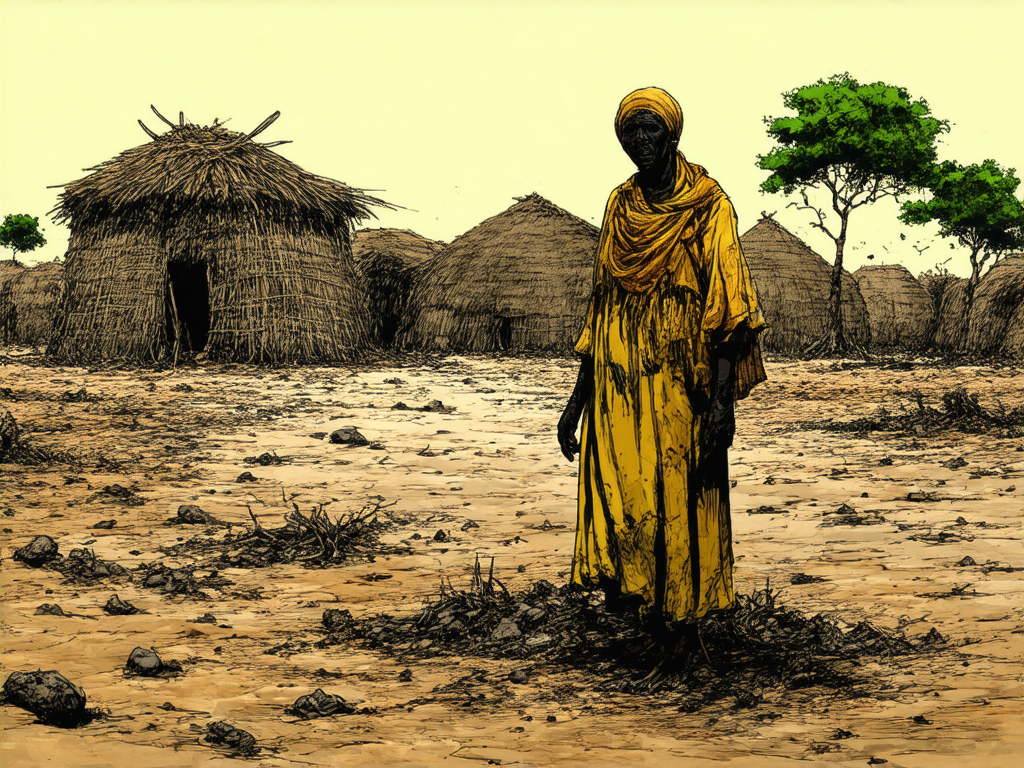
In the arid expanse of Sudan’s Darfur region, where the sky stretches endlessly like an unbroken sheet of blue, the land bears witness to a silent crisis that has left millions in its grip. Famine, once a specter whispered about in hushed tones, has now become the harsh reality for more than 13 million people across this strife-torn nation. The humanitarian emergency is not just a failure of nature but a failure of leadership—a betrayal of promises made and broken by those entrusted with the future of this fractured country.
The story of Sudan’s current plight is one of systemic neglect, political instability, and economic collapse. Decades of mismanagement have eroded the social fabric of a nation already scarred by conflict. The government, mired in corruption and ineptitude, has failed to deliver on its most basic promises: to ensure food security, provide adequate healthcare, and safeguard the rights of its citizens. International aid, meant to bridge the gap left by state failure, has been hampered by bureaucratic red tape, logistical challenges, and a lack of political will.
Yet, amidst this despair, there is a growing chorus of resistance—a movement of activists, journalists, and ordinary citizens demanding accountability and change. They are the ones bearing witness to the unfolding catastrophe, documenting stories that are too often ignored by the global community. Their voices, though muted, are a testament to the resilience of the Sudanese people.
A Nation Betrayed
The roots of the current crisis can be traced back to the early 2000s, when Sudan was already reeling from decades of war and economic mismanagement. The Darfur conflict, which began as an uprising against government neglect, spiraled into a brutal cycle of violence that displaced millions and left entire communities fractured.
But it is not just history that has led us to this point. The current regime, under General Abdel Fattah al-Burhan, has doubled down on policies of repression and austerity, squeezing the already vulnerable population. Basic goods have become unaffordable, with inflation rates soaring to over 300%. Widespread protests, which erupted in October 2021 following the military coup, have been met with a brutal crackdown, further isolating Sudan internationally.
The government’s failure to address these issues has created a vacuum of trust. People who once relied on state institutions now see them as part of the problem, not the solution. “We were promised peace and prosperity,” said Aisha, a mother of four whose husband was killed in the conflict. “Instead, we have been given hunger and despair.”
The Weight of Hunger
In the village of El Geneina, the capital of Darfur’s West region, malnutrition is a daily reality. Children with distended bellies and sunken eyes are a common sight, their bodies struggling to cope with the lack of food. Women walk for miles in search of firewood or water, their faces etched with exhaustion.
The situation is dire, but it is not without hope. Grassroots organizations, often operating under extreme risk, have been working tirelessly to provide aid and raise awareness. These groups are the backbone of Sudan’s resilience, offering a lifeline to those who would otherwise be forgotten by the world.
Yet, even their efforts are stretched thin. “We are doing everything we can,” said Hassan, a local activist, “but without sustained international support, we cannot continue.” The need for global solidarity is clear, but the response has been insufficient. Many countries and organizations have pledged aid, only to see their commitments fall short.
Broken Promises
The international community’s failure to hold Sudan accountable has compounded the crisis. The United Nations and other bodies have issued warnings about the looming famine, but without a coordinated effort to address the root causes, these warnings have fallen on deaf ears.
Meanwhile, the Sudanese government continues to divert attention from its own failures by blaming external forces. “This is not a problem of governance,” said a senior official in Khartoum, speaking anonymously. “It is a problem of sanctions and Western interference.” This narrative, however convenient for the regime, ignores the reality of decades of misrule.
The truth is that the people of Sudan are caught between two failures: their own government’s inability to lead and the international community’s reluctance to act. Both have failed them in their hour of need.
A Call to Action
The situation in Sudan is a wake-up call for the world. It is a reminder that even in an age of unprecedented global connectivity, there are still places where basic human rights are denied and suffering goes unnoticed.
For those who care about justice and equality, the path forward is clear: demand accountability from both the Sudanese government and the international community. Support grassroots organizations working on the ground, amplify the voices of those affected, and push for policies that prioritize human dignity over political expediency.
The people of Sudan deserve better—a future free from hunger, violence, and fear. It is time to honor the promises we have made, not just to them but to ourselves.
This article is a call to action, a reminder that in times of crisis, our shared humanity must always come first. The road ahead may be long, but it is one worth traveling—for the sake of those who have lost hope and for the future generations who deserve a chance to thrive.
About the Author:
Fiona Hart is Chief Editor at our publication. Veteran journalist with over 15 years of experience leading international news operations. Known for her visionary approach to storytelling and editorial strategy, Jane has guided award-winning investigations across continents.
 Bilingual journalist covering Middle Eastern politics and culture. Her reporting bridges the gap between local traditions and global trends, offering unique insights.
 Award-winning reporter specializing in climate change and environmental policy. His work has taken him from the Amazon rainforest to polar regions, documenting the human impact of global warming.
 Veteran journalist with over 15 years of experience leading international news operations. Known for her visionary approach to storytelling and editorial strategy, Jane has guided award-winning investigations across continents.
 Tech and innovation reporter with a focus on the intersection of technology and society. Her work explores how advancements impact global communities and economies.
 Urban affairs correspondent focusing on the challenges and opportunities of rapid urbanization. His work examines how cities shape and are shaped by global trends.